
Just imagine this: you are sitting in front of your interviewer with your hands tightly clasped. At the same time, the conversation turns to why you left your last job.
A pit forms in your stomach, and you hear yourself say, “Well, I was laid off…” before you realize your racing thoughts were “, Was that right to say? Did I just sabotage my chances?
Let’s get real: talking about getting laid off is like walking in a minefield.
And here’s the good news— it doesn’t have to be. In fact, if treated right, your layoff discussion can become one of the opportunities to showcase your resilience, adaptability, and growth. Yes, really.

Image Courtesy: https://deepai.org/
So, do you want to bring that up and let them know you got laid off during the next interview? Okay fine. Let’s, then, break it all down.
Why Do You Bring It Up?
Let’s discuss first why. Discussing your layoff isn’t just a way of airing what happened. It is about regaining power over your life’s narrative.
Being laid off isn’t a failure at being or doing something. Many times, it results from events outside a person’s control:
- Poor economic conditions
- The reorientation of the business
- The evolution in the market of products and services sold
The bottom line is how you tell the story. If you never mention it, interviewers will have their assumptions filling in the blank. But if you do, then you are controlling the message. It speaks of confidence and character.
Advantages and Disadvantages of Discussing Layoffs
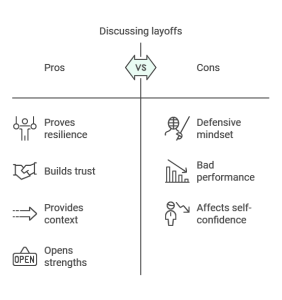
Image Courtesy: https://app.napkin.ai/
Pros:
- Proves Resilience: Discussing your layoff will be how you prove that you were resilient. That shows a capacity for bouncing back and lessons learned. Resilience is very attractive.
- Builds Trust: Transparency signals honesty. Employers do appreciate candidates who are upfront and candid about their journey.
- Provides Context: Addressing the layoff can clarify potential gaps in your employment history, eliminating any lingering doubts.
- Opens the Door to Strengths: It’s an opportunity to pivot the conversation to how you’ve used the downtime productively—perhaps upskilling, freelancing, or volunteering.
Cons:
- Defensive or Fixated: Talking much about layoff gives a defensive or fixated appearance on the past.
- Bad Performance: Though attitudes are improving, some employers might still consider layoffs as bad performance.
- Affects Self-confidence: If the layoff is sensitive, talking about it would affect your composure or self-confidence.
How To Talk About Your Layoff-Without Making It Awkward
Having balanced the pros and cons, here’s the take-home rule: brief, professional, and hopeful. Sounds easy? Here are five ways to make it manageable:
- Reshape the Story: Put your layoff in the positive category: a step forward instead of a step back. “The layoff made me refocus on my career direction and move forward to things that work much better with my abilities.”
- Be Objective, Not Emotional: Tell what you have achieved, rather than what you have lost.
- Growth: What’s the trajectory of your professional growth? What courses, workshops, and side projects have you done? Show
- Practice Delivery: Practice so much that it becomes habitual. The delivery of confidence is just as important as the content itself.
- Topic Change: After bringing up the layoff, divert the conversation into a discussion regarding how your abilities and experience match the job.
Effective Conversation Scripts on How to Answer Layoff Questions
Scenario 1: Economic Restructuring
“The company went through severe restructuring post the [economic slowdown, industry trends, etc.], that brought in some layoffs – and indeed, myself. Undeniably an event that comes out of nowhere, yet has been able to find its way into continuing to hone the skills in the areas of [specific skills or industrial domains] and looking forward to contributing that experience in this role”.
Scenario 2: Downsizing As An Employee Of The Team
“Unfortunately, my previous employer downsized the whole team due to market conditions. These decisions, I feel, are hardly personal, so I have continued to upgrade my skills in [specific area] in preparation for the future.”
Scenario 3: Termination of the Whole Department
They literally shut down the department where I work. Bad timing, of course, but this made me have a second thought about my career, which had to chase some specific projects, certifications, and goals. It is from such experiences that I think those will only increase my contribution even more toward this job.
What NOT To Say In Your Layoffs Talks
- Finger-Pointing: Do not speak badly of the previous organization or employees. That goes heavily against you.
- Too Honest: Do not tell each and everything in relation to being laid off by them. Talk very superficial and minimalistic.
- Bad Vocab: Avoid using phrases “got fired,” or “axed”. Use repositioning and downsizing.
- Sounds like You’re not ready: If you sound nervous or stutter, it sounds like you are trying to hide. Get yourself ready.
Take it Back into the Future
You just survived the layoff talk; however, now that you passed through this conversation. You are going to need to push this subject all back toward talking points surrounding your abilities, passion, and relevance for this role. This transition could be helpful:
“While the layoff was a turning point in my life, it helped me to focus on growth and reflection. I am particularly excited for this opportunity because [specific reason why you’re interested in this role], and I’d love to bring [specific skills] to your team.”
A Layoff isn’t the End; It is a New Beginning
Let’s rewrite that layoff story together. Instead of this professional scarlet letter, think of it as just another chapter in your career story filled with resilience, growth, and transformation.
Tackling it head-on, with poise and perspective, leaves a lasting positive impression on the interviewer.
Absolutely, yes. So, actually not such a bad idea to discuss when the next interview rolls around a layoff. Own that story, show growth, and keep your eyes on that opportunity ahead. You’ve got this.