Let’s paint a picture: It’s 9 PM, and you’re finally sinking into the sofa after a long day. Then, ping!—your phone buzzes with an email marked “urgent.” Sounds familiar? It’s the modern workplace curse: the expectation that we’re always on.
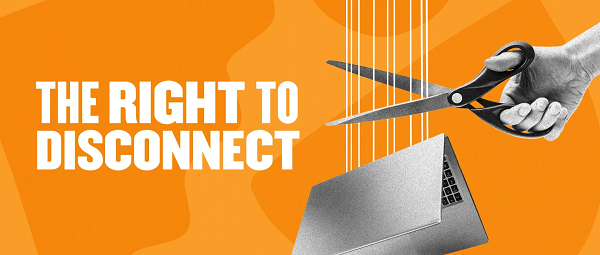
The “Right to Disconnect” term was coined to challenge this form of digital shackling. It’s much more than a new buzzword in HR; it is a movement for employees to switch off after working hours without fearing backlash.

Image Source: https://gokulamseekias.com/
But must employers enforce this rule? Let’s jump into why it matters and what it could mean for businesses and employees alike.
What is the Right to Disconnect?
It’s all about the boundaries at its core. The policy gives staff the right to completely ignore any work emails, calls, or messages during off-hours. No pings sneaking in on dinner. No midnight Slack message. Pure, unadulterated off-the-clock time.
The right to disconnect is a proposed human right (no blanket implementation yet, worldwide) that allows employees to disengage from work-related communications outside of work hours: emails, text messages, and phone calls.
Such laws have been enacted in places like France since 2017 and made employers respect employees’ personal time. Other nations followed in later years; Italy, Belgium, and Portugal did so.
Sounds idyllic, yet it brings very practical questions of enforcement, whether or not it is culturally enforceable, and what attitude the theory takes toward work.
Why Should Employers Care
Employers may think that a “Right to Disconnect” would cut productivity. But here’s the thing: it might increase it.
Productivity doesn’t top out when people are overworked; it bottoms out. Working overtime has been relative to burnout, higher absenteeism, and even turnover.
In 2021, Gallup (Workplace Consulting & Global Research Organisation) estimated that the cost of burnout would dent businesses around £100 billion each year in lost productivity.
Picture this: Employees arrive at work revitalised, re-energized, and refreshed instead of writing those late-night emails. It’s an adage about quality versus quantity, and it cuts it.
The Human Perspective on Disconnecting
Now, let’s discuss the people not as employees but as people.
We all need to rest. It could be family time, hobbies, or simply binge-watching your favourite series; downtime helps recharge our mental and emotional energy.
Take the case of Sarah, for example; she used to reply to emails till 11 at night. And when daylight broke, she had already exhausted herself even before the actual work began.
It entirely flipped with her “Right to Disconnect” initiated by the company. She now retains evenings, has bettered sleeping habits, and is going places at work.
Nor is this just anecdotal evidence. Scientists from Warwick University conclude that happier employees work 12% harder. Protecting personal time isn’t merely mercifull—it’s smart business practice.
Counterarguments: Are there Disadvantages?
Of course, not everyone is convinced. Opponents argue that too much of a rules-oriented approach would stifle flexibility. What if an important matter arises? Wouldn’t strict rules strangle employers?
These are legitimate arguments, but they’re also controllable. Employers can design policies that carve in exceptions for real emergencies while deterring routine after-work-hours contacts. It’s not to ban all contact but rather to set reasonable expectations.
Striking a Balance: Tips for Employers
If you are an employer wondering how to introduce the “Right to Disconnect” without chaos, here is how:
- Set Clear Policies: Define what the “Right to Disconnect” means for your workplace. Specify hours, communication methods, and exceptions.
- Lead by Example: Leadership needs to practice what they preach. If managers send late-night emails, employees will feel compelled to respond.
- Embracing Technology: Tools like email schedulers delay non-urgent messages.
- Training: Employees must be taught the effective management of time during work hours, making after-hours work unnecessary.
- Measure and Tweak: Regularly review the policy for the way it affects productivity and morale. And do not be afraid to change the approach when it is warranted.
Practical Victories
In Portugal, a law prohibits employers from calling employees after office hours, and firms report that the level of morale is improved. The employee feels valued by this consideration, and the employer benefits in return by having a better-performing workforce.
Closer to home, some UK companies have embraced such policies on a voluntary basis. A recent poll showed that 78% of employees would be more loyal to firms that respect personal time.
The Bigger Picture
Zoom out for a moment. It is not just work emails or phone calls but something related to culture.
It is an unsustainable attitude for being “always on”. Blurring work-life boundaries means creating an exhausted and disengaged workforce all the time.
Introducing “Right to Disconnect,” tells the employees loudly, we care about your time; we care about your health; we care about your happiness. Isn’t that the kind of workplace we want to be part of?
In Passing
So, should employers enact a “Right to Disconnect” rule? Absolutely. Not merely because it is humane but because it makes smart business sense.
When employees flourish, businesses do, too. It really is that simple. So, let’s start a new chapter in workplace culture where rest is respected, boundaries are honoured, and the ping of an email does not hold power over your evenings.
In all cases, the right to disconnect is no longer a luxury but a necessity for the modern worker.