After the COVID-19 pandemic, things that we used to know could not be done from a distance, have become the ‘new normal’. This concept has changed beyond our social values, it has turned our thoughts on life into new goals. However, there are impacts and consequences that we have accepted in our professional lives. Offices are transformed into Work from home and a new perspective was born.
With the improvement in the situation, the hybrid model was developed. Now, the new working mode offers work from the office or home or a hybrid mode. But here we will focus mainly on which of the working modes are more convenient – WFO or WFH?
Are working from home is better? or it should be the hybrid mode? But before all of these, we must check what makes this concept different from each other.
As per the report, by Robert Half, almost 26% of employees are into fully remote working, on the other hand, approx 25% of them support work from the office. Meanwhile, the rest of them are in favor of a hybrid model that offers half work from the office and half at home. However, research also shows that 1 in every 3 professionals who are currently working from home would love to have the opportunity to work from the office.
Work From Home Vs Work From Office
Work From Home: What Is It?
In Work from home model, employees of an organization work from their residence. In this model of working, video conferencing and audio calls are the only options for employees to interact with each other.
Work From Office: What Is It?
WFO or work from office requires employees to work in the office or on-site. This model demands professionals to attend to the office premises throughout the specific working hours.
The New Concept Of The Hybrid Model
The hybrid model suggests working from both: the office and home. This is where employees have the privilege of working from their site of residence along with the office premises. For instance, employees can work for three days from the office, and for the rest of the days, they can work from home or anywhere. However, the authorities of the organization decide on which days the employees would have to be present in the office.
Work from Home- Advantages & Disadvantages
WFH or work-from-home has appeared as a long-term option to the traditional process of offices. As employees have the freedom and flexibility to work at their time from the comfort of their home. As a result, it increases productivity. Most of the ITs and Software firms such as Infosys, TCS, IBM, etc. prefer this option of working from home even before the covid-19. However, this alternative was largely developed as a liberty and was only bestowed to employees whose job obligations were suited for such an understanding. Check out the advantages of work from home model:
The key difference between WFH vs WFO:
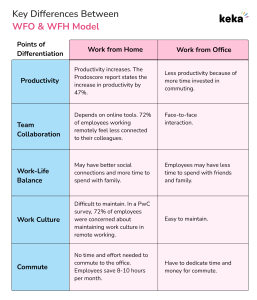
Most people prefer working from home which is greatly favored by employers also; however, this model may include certain catches. Different investigators from worldwide suggest that working from home must include specific requirements and essential conditions to make it adequate and successful. These are the disadvantages of working from home:

Work from Office- Advantages and Disadvantages
Unlike WFH, working from the office offers better collaboration between the members of the team and allows for easy management of discomfort. Moreover, personal or face-to-face communication allows the employees to conclude the tasks faster. In spite of its great advantages, working on-site may have certain drawbacks. Let’s check out the pros and cons of working from the office.
Advantages of WFO
- Better experience in the distribution of workspace
Office environments are highly optimized and assist in carrying out the functions seamlessly. It also enhances the interactions between team members and other cross-functional teams.
- Teamwork
Leading and working in a team elevates employees’ social, cooperation, and conflict management aptitudes. It also promotes creativity and consequences in a productive workspace.
- The comfort of working face-to-face meetings
Some projects need more personal cooperation with other team members. while employees work from the office, they have the freedom to drive face-to-face meetings with different teams. Besides, they can transfer their points of view on critical issues like organizing a business proposal or setting a meeting with an important client.
- Social engagement
Meeting people closely, and talking with them offers better social connections as the office gives the opportunity. You can communicate directly and convey your opinion. Moreover, you can cultivate new ideas and concepts when working from the office.

Disadvantages of Work from Office
Common distractions
Communicating with co-workers very often leads to a gathering and distraction from work. At times, the ongoing communication from each team member will become distracting for others and make the workplace noisy.
Lack of privacy
In office, there are different kinds of people working together. Among them, more introverted people may face a lack of privacy. They may have discomfort while teaming with members, leading to inappropriate interactions or a lack of supervision skills.
More pressure or office tension
While working with the team leaders in the office, colleagues may feel under stress due to excessive workload. Sometimes, it happens in a continuous process. It may make employees feel anxiety which leads reduction in productivity and working capacity.
Moreover, workers have to spend their traveling time and money to get to their office on time. It also ushers congestion on the road and the use of resources. Considering the advantages and disadvantages of working from home vs working from the office is required before determining on which working mode to choose.
Working from Home vs. Working from Office: The Psychological Effects
Depending on the nature and preferences, the psychological effects of working from home vs working from the office vary for different people. It relies on individuals’ choices, job roles, and any particular work environment. Here is the checklist of the key psychological effects of working from home vs. working from the office.
Work from Home or WFH
- Loneliness and Seclusion: A continuous process of working from home may lead some people into isolation and loneliness, specifically if they live isolated. It can be the cause for an employee who develops gradually a feeling of the absence of regular social interactions with coworkers.
- Freedom and Flexibility: WFH offers employees the space and flexibility to prepare their work environment and plan to perform their performance. Moreover, for some individuals, this can lead to more job satisfaction and minor stress.
- Work-Life Balance: WFH can assist many employees with their work-life balance by releasing the need for traveling and providing them more power over their everyday practice. However, this provides minimal stress and better health.
Work from Office
- Social Relations: Having regular face-to-face meetings with coworkers in an office environment fosters a sense of harmony and social contact. This may have a good effect on both mental health and job satisfaction.
- Scheduling and structure: WFO often offers a pattern with predetermined conception and ending times. For some individuals, the stability and regularity of this routine might assist in reducing anxiety.
- Experienced Individualism: Employees may strengthen their feeling of professionalism and affection with the team by attending the office or the organization. Self-esteem and job satisfaction may improve as a result.
Both of the working methods have their own benefits and drawbacks. However, the preference depends on employees’ choices and how the organization’s responsibility for who wants to function. Each positive and negative effect must be considered carefully when selecting the work-from-home vs. work-from-office model.