In today’s perpetually changing world, AI is regarded as the epitome of human innovation. To most employees, AI does not mean a technological advancement but a revolution, for it is a precursor of transformation that is raising the bar and shattering career ceilings. Imagine a world where lethargy becomes automated, creativity is let loose, and new career paths materialize from the confluence of the human imagination and AI at work. This is not some sci-fi movie set in the 2050s but a reality we are entering.

Image Source: https://www.bitrix24.in/articles/ai-in-the-workplace-balancing-automation-and-human-touch.php
New Epoch Begins
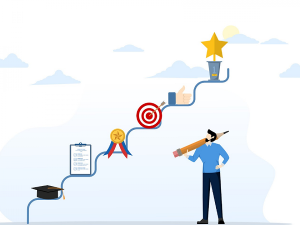
Not until long ago, careers were linear, predictable, and mostly constrained by the ceiling that seemed impossible to break. Employees would join the company, climb up the hierarchical ladder, and retire after a lifetime of service. That was the order of the day. But today, AI rewrites this narrative. It is an age where the sky is no longer a limit but a starting point.
The abilities of AI range from the mechanization of routine tasks to deep insights that derive from various data analyses. It is something similar to a tireless, all-knowing assistant who doesn’t sleep and is learning and developing all the time. For employees, this also means more time devoted to strategic, creative, impactful and innovative work. Leaving the mundane to the machines, humans do what they best do: innovate, strategize, and create precisely in that order.
Breaking the Career Ceiling
For decades, workers have had to contend with the nemesis of the career ceiling: that unseen barrier to upward mobility or growth caused either by a lack of opportunities, a skills mismatch, or organizational constraints. AI is the hammer that smashes the ceiling.
Now, consider the development of AI-powered tools across industries. For instance, AI in healthcare helps in diagnosis, predicting patient outcomes, and personalizing treatment plans. This would improve patient care and also help health professionals expand their roles beyond traditional bounds. In marketing, AI analyzes consumer behavior, predicts trends, and automates campaign management, letting marketers, therefore, focus on strategy and creative execution.
To modern employees, AI is not a replacer but an enhancer. It improves their capabilities, equipping them with all the tools needed for excelling in their job roles and to create new avenues for themselves. In this paradigm shift, career growth is no longer a vertical rise in the hierarchy; rather, it is moving in a web of opportunities where each thread is connected to the other through AI-driven innovations.
The Skillset Resurgence
With the increasing AI penetration in the workplace, a new set of competencies is likely to take the lead. Instead of becoming redundant, employees will instead get an opportunity for continuous learning and development. Therefore, this may be considered a sort of skillset rejuvenation—a period when upskilling and reskilling will become a regular part of day-to-day life in light of the vigorous nature of AI technologies.
Creativity, emotional intelligence, strategic thinking—all these soft skills—are acquiring a higher and higher value. These are areas where AI isn’t necessarily exceptional at this point, while human beings are. Those workers who put these skills to work in conjunction with technical expertise in the tools related to AI will be at the edge of this revolution.
Organizations are hence investing in some serious training programs to equip their workforce with the proper prowess to survive an AI-driven environment. Online courses, workshops, and certifications make it much easier than before for any employee to stay relevant and competitive. The emphasis is on a growth mindset wherein learning is continuous, and adaptability becomes consequential.
Adopting Change
Especially in the case of AI, change at such a large scale can be quite daunting. On the other hand, change brings with it some great opportunities as well. To the employees, the pressure from AI means stepping out of their comfort zones into a whole new world of possibilities. To be proactive, looking for new challenges, and using AI in enhancing and promoting one’s career.
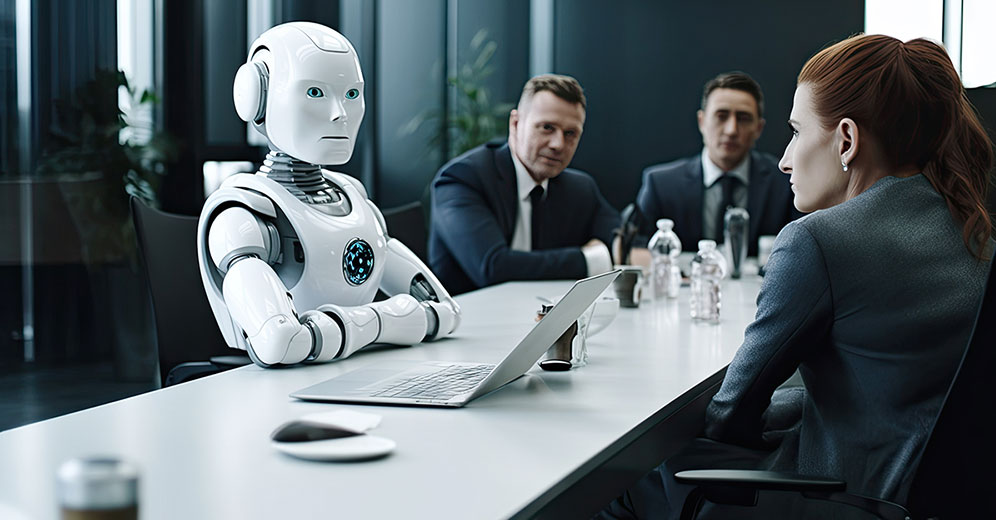
AI’s impact is going to be profound in the workplace. At the heart of this new era is the collaboration of man with machine. The employee needs to open up to AI as his colleague, not as his rival. It is this mindset that will let AI reach its full potential and deliver the various benefits it can.
Consider AI-driven project management tools that can automate scheduling, task allocation, and progress tracking. It would provide more time for the project manager to work on leadership, team dynamics, and strategic decision-making. The outcome would be a more effective and efficient way of managing projects where AI takes care of the logistics and humans provide the vision and direction. AI can take care of PERT (project evaluation and review technique) and define the CPM (critical path method) in every project.

Image Source: https://www.technewsworld.com/story/experts-say-workplace-ai-bans-wont-work-178537.html
New Career Paths
Probably one of the most exciting aspects of this integration of AI into the workforce is the new career paths that are opening up. AI specialists, data scientists, machine learning and prompt engineers, were unheard of, and these roles were barely in existence ten years ago and have now become some of the fastest-growing jobs within the current job market.
Traditional roles are morphing into AI-related responsibilities. Today, a marketing manager may be required to have an understanding of AI-driven tools of analytics, while a financial analyst may use AI for predictive modeling and to assess the financial risk involved. In this way, traditional and new skill sets are being combined to create a highly dynamic job market with many opportunities for those who adapt and are ready to learn.
For employees, this means the possibility and a chance of reinventing themselves. Career transitions are no longer setbacks; rather, they are ways of learning, experiencing and implementing new things. AI drives such a paradigm shift, providing the tools and insights that make one’s transition into new career landscapes effortlessly possible.
The Moral Angle
As the yesteryear adage goes, with great power comes great responsibility, and it’s no different for AI. Although AI is revolutionizing the workplace, it has come with a bucket of associated ethical considerations employees and organizations must grapple with—things like privacy, bias, and transparency.
These dimensions are very important for every employee to understand. It’s not simply about using AI for the purpose of career growth but doing it in a responsible and fair manner. An employee should champion the ethical use of AI and ensure that the application empowers inclusivity and fairness in the workplace.
Organizations, on their part, should foster a culture of ethical application of AI. It requires setting up guidelines and policies in the use of AI transparently and free from bias. Training modules on the ethical use of AI will help the employees work out the complex issues involved, making these professionals not only talented employees but also ethical leaders in the AI workplace.
AI and Work-Life Balance
One of the lesser discussed but equally important aspects of how AI will impact the workplace is improving work-life balance. AI can reduce the amount of workload and stress levels of employees with functions such as automating routine tasks and providing real-time insights, hence providing a much healthier work-life balance.
AI can handle all the administrative tasks, from scheduling meetings to drafting emails. Employees, as a result, get to focus on high-value tasks that really require human ingenuity and creativity. This shift brings enhanced productivity and allows workers to have time for their personal interests and live a balanced life.
Leadership’s Role
Leadership in the age of AI is not about understanding; it is guiding and inspiring a workforce through the significant workplace change no human had ever envisaged. Leaders have to be visionaries, reading into the potential of AI and its overall effect on the workplace. In addition, they must also be compassionate—able to recognize the apprehensions and concerns of their team and thus be able to render the support necessary for navigating this transformation.
Outstanding leadership has to foster a culture of continuous learning and innovation. Leaders must empower staff to embrace AI by giving them tools and support necessary for upskilling and reskilling. In doing so, they will have created an environment whereby the employees feel valued and empowered enough to take on the challenges and opportunities associated with AI.
Few Examples:
The impact of AI at work is best understood through real-world examples. Consider a multinational financial services company seeking to introduce AI into customer service operations. This organization was able to reduce response times significantly and improve customer satisfaction by deploying AI-driven chatbots against routine inquiries. On the other side, employees could concentrate on complex issues that provided higher job satisfaction and career growth opportunities.
Another example could be a manufacturing company that had introduced AI into its production processes. The company began, through AI-driven predictive maintenance tools, to see potential equipment failures well ahead of time and avoid them by reducing downtime, which brings efficiency gains. Workers have been trained to use those new tools; moreover, these workers are gaining new and valuable skills in the process. The impact—a more effective production line and a more empowered, engaged workforce.
The Future of AI in the Workplace
AI has just stepped into the workplace, and as technology evolves further, its impact on careers and job roles will also have a positive effect. Employees should be prepared to adapt to this change and view AI not as a threat but as a potent tool for growth and innovation.
The future will see an increasing integration of AI into the workplace—machine learning, natural language processing, and robotics. These technologies will further drive productivity, creativity, and collaboration in creating a dynamic, inclusive, and future-looking workplace.
Image Source: https://vinggle.com/photo/512/ai-artificial-intelligence-technology-computer
For employees, AI will be a real game-changer: raising their role, breaking barriers, and opening up new vistas of opportunity. The career ceiling, now an impassable barrier, is shattered by the persistent march of AI-driven innovation.
Embrace this change, for it is not just a technological shift but a revolution in our working and growing formats. AI is here to stay, and with that comes a future where our imagination is the only limit.